
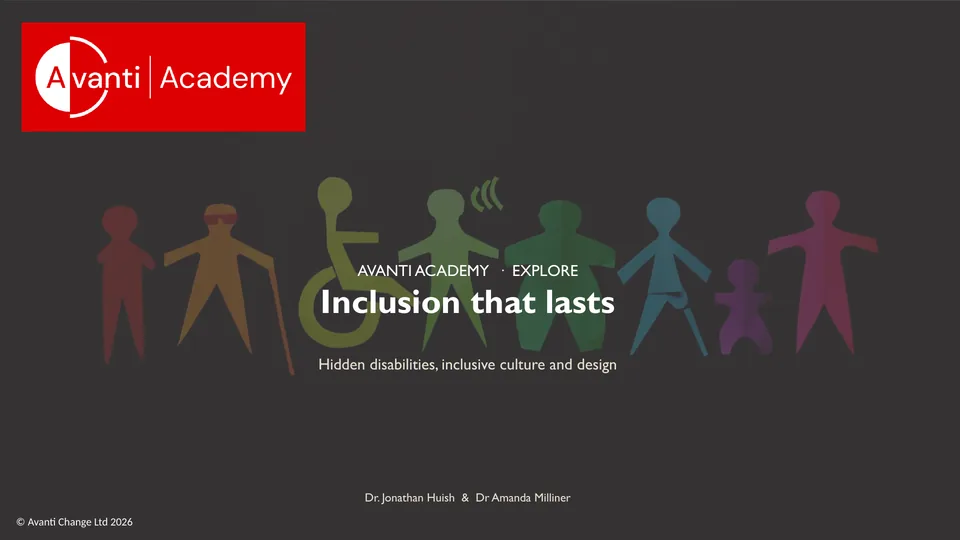
Inclusion that lasts
Hidden disabilities, inclusive culture and design.
A half day on inclusion that lasts: hidden disabilities, neurodiversity, building culture and psychological safety, accessible design, inclusive leadership, what works in EDI and three major UK cases.
- Level
- Explore
- Learning time
- 5 hours 30 minutes
- Where
- Leading people
- Price
- £129
When you step up to a higher level, what you paid in the last 12 months for lower-level courses inside the bigger course comes off its price, in proportion to how much of each is inside it, whichever topic it's from. Courses at the same or a lower level don't give credit against each other. A Focus course or above always costs at least £15. Read the full terms
Certificate of Completion, or Certificate of Completion and Assessment with a short assessment
Overview and Outcomes.
Who It's For
Leaders, managers and HR and EDI professionals in public services and the voluntary sector
Overview
Many colleagues live with conditions you cannot see, and culture is set by what leaders tolerate, notice and reward. This half day completes Fair by design and begins with hidden disabilities, spoon theory and the Hidden Disabilities Sunflower, then neurodiversity and Nancy Doyle's spiky profile. Building culture and psychological safety follow, with Schein, Edmondson and Coyle. Inclusive design runs from the curb-cut effect to Ron Mace's universal design, and inclusive leadership draws on the 5Ds of bystander intervention and the Welsh Rugby Union review. The closing section explores Dobbin and Kalev on what works and a capstone on Windrush, the London Fire Brigade review and Yorkshire County Cricket Club.
Aims
Everything here is designed to help leaders make inclusion outlast the launch: supporting colleagues with unseen conditions, designing out barriers before people meet them, building cultures where it is safe to speak, and measuring progress honestly with named accountability rather than relying on good intentions.
In summary, you will be able to:
- Plan flexible adjustments for fluctuating conditions, and create conditions in which disclosure of a hidden condition feels safe.
- Apply the curb-cut effect and the seven principles of universal design to a service, building or document you manage.
- Judge what turns accepted recommendations into lasting change, drawing on Windrush, the London Fire Brigade review and Yorkshire cricket.
What you'll develop
Across this Explore, you will develop the ability to:
- Explain how the Equality Act definition of disability applies to hidden, recurring, treated and fluctuating conditions, including mental health conditions.
- Distinguish neurodiversity from neurodivergent and compare the deficit, superpower and spiky profile framings of neurodivergence.
- Identify Schein's embedding mechanisms, both day to day and through systems, and explain why they shape culture more than formal statements.
- Explain what psychological safety is and is not, and how it combines with high standards to create a learning zone.
- Apply the curb-cut effect, the seven principles of universal design and the persona spectrum to a service, building or document you manage.
- Explain why presence is not inclusion, using the diversity bonus, Deloitte's six signature traits and peer-reviewed evidence on inclusive climates and psychological safety.
- Distinguish the control tactics that Dobbin and Kalev found tend to fail from the engagement, contact and accountability approaches that work.
- Analyse a case by asking what the system did, not only what people intended, avoiding both the few bad individuals mistake and the everyone is guilty mistake.
Built from 8 modules.
5 hours 30 minutes of learning.
- 01Hidden Disabilities and Long-term ConditionsEqualities and Diversity39 min
- 02Neurodiversity at WorkEqualities and Diversity42 min
- 03Building and Changing Culture, and Culture in MergersCulture in Organisations44 min
- 04Trust, Safety and Strong CulturesCulture in Organisations41 min
- 05Accessible and Inclusive DesignEqualities and Diversity40 min
- 06Inclusive Leadership, Allyship and CultureEqualities and Diversity41 min
- 07Making EDI Stick: Data, Targets, Backlash and What WorksEqualities and Diversity41 min
- 08Applied Case Studies: CapstoneEqualities and Diversity42 min