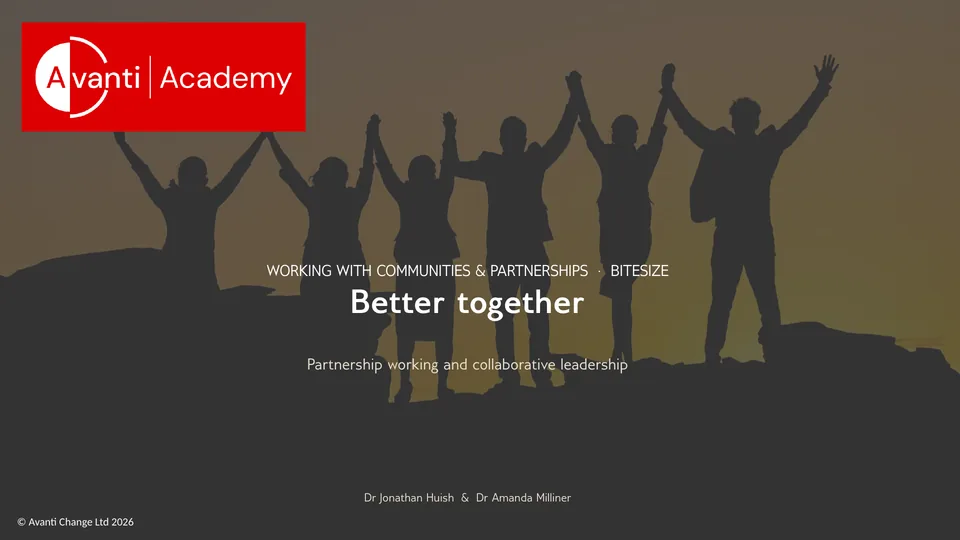
Better together
Partnership working and collaborative leadership.
- Level
- Bitesize
- Learning time
- 1 hour 30 minutes
- Where
- Working with Communities and Partnerships
- Price
- £39
When you step up to a higher level, what you paid in the last 12 months for lower-level courses inside the bigger course comes off its price, in proportion to how much of each is inside it, whichever topic it's from. Courses at the same or a lower level don't give credit against each other. A Focus course or above always costs at least £15. Read the full terms
Certificate of Completion
Overview and Outcomes.
Overview
Partnership is a word used so loosely it can mean almost anything. This module offers a working definition of partnering, unpacks the words sustainable, collaborative and across sectors, and explains why partnership working has intensified. It introduces the partnership continuum from spectator to transform, five different purposes a partnership can serve, and the characteristics of effective partnerships, closing with why every partnership is contested space. Leading a partnership is a different skill from leading an organisation, because you carry the outcome without holding the controls. This module treats partnerships as contested space, sets out design principles and golden rules, applies Bruce Tuckman's stages to partnerships, and draws on Rosabeth Moss Kanter, Madeleine Carter and Morten Hansen to describe the qualities and behaviours of collaborative leaders, ending with a self-check.
What you'll develop
In this Bitesize, you will develop the ability to:
- Explain the working definition of partnering and use four questions to test whether a new partnership is genuinely needed.
- Identify where a partnership sits on the continuum from spectator to transform and recognise the common mistakes the continuum exposes.
- Assess a partnership against the characteristics of effectiveness and name its purpose honestly, from talking shop to blue skies thinking.
- Explain why every partnership is contested space and use four practical moves to bring negotiated goals, unequal power, working assumptions and competing accountabilities into the open.
- Plan a partnership's design using the four design questions and the golden rules, starting by agreeing the purpose before the structure.
The Modules.
1 hour 30 minutes of learning.
- 05Foundations of Partnership WorkingPartnership is a word used so loosely it can mean almost anything. This module offers a working definition of partnering, unpacks the words sustainable, collaborative and across sectors, and explains why partnership working has intensified. It introduces the partnership continuum from spectator to transform, five different purposes a partnership can serve, and the characteristics of effective partnerships, closing with why every partnership is contested space.41 min
- 06Leading Through PartnershipLeading a partnership is a different skill from leading an organisation, because you carry the outcome without holding the controls. This module treats partnerships as contested space, sets out design principles and golden rules, applies Bruce Tuckman's stages to partnerships, and draws on Rosabeth Moss Kanter, Madeleine Carter and Morten Hansen to describe the qualities and behaviours of collaborative leaders, ending with a self-check.41 min
Keep going.
Part of the Working with Communities and Partnerships topic, also sold whole as Common cause.
Go deeper, and pay only the difference
- You are hereBitesize, 1 hour 30 minutes, £39
- Next stepFocus, Partners in practice, 3 hours 30 minutes, £69. Already own the Bitesize? You pay £30.
- The whole topicExplore, Common cause, 6 hours, £129. Already own the Bitesize? You pay £90.
When you step up to a higher level, what you paid in the last 12 months for lower-level courses inside the bigger course comes off its price, in proportion to how much of each is inside it, whichever topic it's from. Courses at the same or a lower level don't give credit against each other. A Focus course or above always costs at least £15. Prices per person. Read the full terms
Also part of: Serving your community well, Beyond our own walls, Stronger together
Other Bitesize in the Working with Communities and Partnerships topic
- Rungs of real influenceCommunity and the Participation Ladder1 hour 30 minutes£39
- Building on what is strongAsset-based community development (ABCD)1 hour 30 minutes£39
- Making it work across boundariesCo-production and cross-organisational working1 hour 15 minutes£39
- Partnership in the real worldCommunity and partnership case studies30 minutes£39