
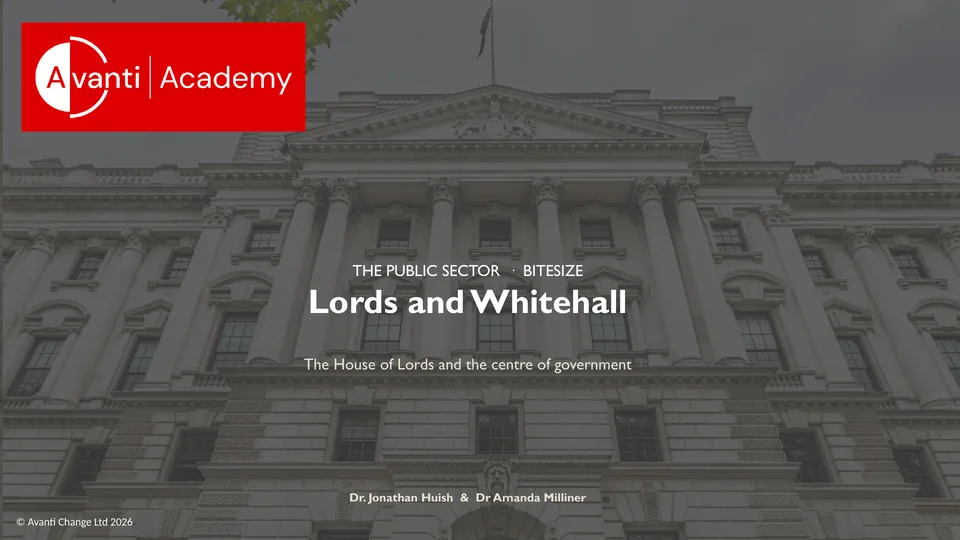
Lords and Whitehall
The House of Lords and the centre of government.
- Level
- Bitesize
- Learning time
- 1 hour 30 minutes
- Where
- The Public Sector
- Price
- £39
When you step up to a higher level, what you paid in the last 12 months for lower-level courses inside the bigger course comes off its price, in proportion to how much of each is inside it, whichever topic it's from. Courses at the same or a lower level don't give credit against each other. A Focus course or above always costs at least £15. Read the full terms
Certificate of Completion
Overview and Outcomes.
Overview
This module explores the House of Lords as a revising rather than a governing chamber, and why it cannot block the elected government under the Parliament Acts of 1911 and 1949 and the Salisbury Convention. It compares Lords and Commons committees, traces reform from 1911 to the House of Lords Hereditary Peers Act 2026, and asks what gives an unelected chamber standing to shape national law. This module looks at how the machinery of British government is run: the scale and top roles of the Civil Service, its functions of advice, delivery and continuity, the four Civil Service Code values and merit based recruitment. It compares the constitutional theory of ministerial accountability, including the Carltona principle, with committee practice, then examines Number 10, the Cabinet Office, the 2026 Civil Service review and No.10 North.
What you'll develop
In this Bitesize, you will develop the ability to:
- Explain why the House of Lords can revise and delay legislation but cannot block the elected government, using the Parliament Acts and the Salisbury Convention.
- Compare the cross cutting, expert led work of Lords committees with the departmental model of Commons select committees.
- Assess what the House of Lords Hereditary Peers Act 2026 changed and what it left open about the legitimacy of an appointed chamber.
- Describe the structure, functions and four core values of the Civil Service, and how merit based recruitment makes impartiality achievable.
- Distinguish the constitutional theory that ministers alone answer to Parliament from the practice of Permanent Secretaries giving evidence as Accounting Officers.
- Assess current changes at the centre of government, including No.10 North and the Cabinet Secretary's review, without assuming their outcome.
The Modules.
1 hour 30 minutes of learning.
- 03Westminster II: The House of LordsThis module explores the House of Lords as a revising rather than a governing chamber, and why it cannot block the elected government under the Parliament Acts of 1911 and 1949 and the Salisbury Convention. It compares Lords and Commons committees, traces reform from 1911 to the House of Lords Hereditary Peers Act 2026, and asks what gives an unelected chamber standing to shape national law.39 min
- 04Whitehall and the Centre of Government: The Civil Service, No10 and No10 NorthThis module looks at how the machinery of British government is run: the scale and top roles of the Civil Service, its functions of advice, delivery and continuity, the four Civil Service Code values and merit based recruitment. It compares the constitutional theory of ministerial accountability, including the Carltona principle, with committee practice, then examines Number 10, the Cabinet Office, the 2026 Civil Service review and No.10 North.43 min
Keep going.
Part of the The Public Sector topic, also sold whole as How the public sector works.
Go deeper, and pay only the difference
- You are hereBitesize, 1 hour 30 minutes, £39
- Next stepFocus, The national picture, 2 hours 30 minutes, £69. Already own the Bitesize? You pay £30.
- Explore, Power at the centre, 4 hours, £129. Already own the Bitesize? You pay £90.
- The whole topicImmerse, How the public sector works, 10 hours, £249. Already own the Bitesize? You pay £210.
When you step up to a higher level, what you paid in the last 12 months for lower-level courses inside the bigger course comes off its price, in proportion to how much of each is inside it, whichever topic it's from. Courses at the same or a lower level don't give credit against each other. A Focus course or above always costs at least £15. Prices per person. Read the full terms
Also part of: Knowing the public landscape
Other Bitesize in the The Public Sector topic
- Westminster from the insideThe public sector map and the House of Commons1 hour 30 minutes£39
- Wales and the NHSThe Senedd and the NHS in England1 hour 30 minutes£39
- Health and policingThe NHS in Wales and policing governance1 hour 30 minutes£39
- Fire and the council differenceFire and rescue governance and how local government differs1 hour 30 minutes£39
- Housing and working togetherWhere housing sits, and multi-agency working1 hour 30 minutes£39
- Two nations comparedEngland and Wales compared, with case studies1 hour 30 minutes£39