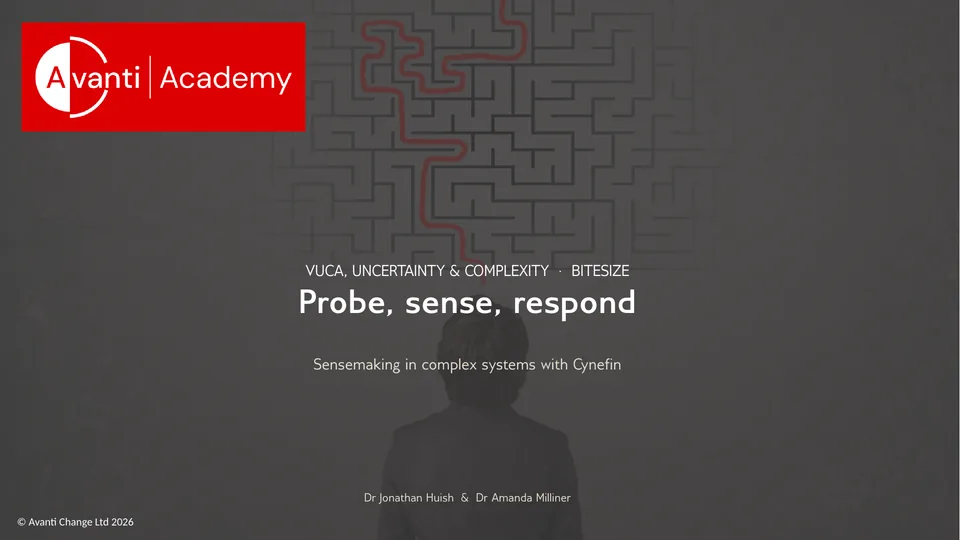
Probe, sense, respond
Sensemaking in complex systems with Cynefin.
- Level
- Bitesize
- Learning time
- 1 hour 15 minutes
- Where
- VUCA, Uncertainty and Complexity
- Price
- £39
When you step up to a higher level, what you paid in the last 12 months for lower-level courses inside the bigger course comes off its price, in proportion to how much of each is inside it, whichever topic it's from. Courses at the same or a lower level don't give credit against each other. A Focus course or above always costs at least £15. Read the full terms
Certificate of Completion
Overview and Outcomes.
Overview
In complex conditions you often act your way to clarity rather than analysing your way there. This module introduces Karl Weick's sensemaking and its seven properties, especially the enactive idea that a team's story shapes what happens next, alongside the basics of complex adaptive systems: agents, feedback, emergence and non-linearity. The 2010 Flash Crash shows why hunting for a single root cause can fail, and three habits support learning forward. When you cannot analyse your way to an answer, you need a disciplined way to act. This module turns Snowden's probe, sense, respond into practice: what makes an experiment safe to fail rather than fail-safe, how probes quietly stop being safe, a five-step design sequence, and amplifying and dampening emergent patterns instead of mandating. The NHS vanguard sites show parallel probes, with honestly mixed results, at system scale.
What you'll develop
In this Bitesize, you will develop the ability to:
- Explain how Weick's sensemaking reverses the conventional analyse, decide, act sequence, and identify when careful analysis still fits better.
- Describe the four basic properties of a complex adaptive system and use them to explain why hunting for a single root cause can fail.
- Apply three sensemaking habits, including narrating out loud and holding your current story loosely, to a live situation in your own work.
- Explain why best practice and good practice fail in the Complex domain, and distinguish probe, sense, respond from the act, sense, respond needed in chaos.
- Design a safe-to-fail experiment that is small, reversible, instrumented and run in parallel, with an exit point agreed in advance.
The Modules.
1 hour 15 minutes of learning.
- 05Sensemaking in Complex SystemsIn complex conditions you often act your way to clarity rather than analysing your way there. This module introduces Karl Weick's sensemaking and its seven properties, especially the enactive idea that a team's story shapes what happens next, alongside the basics of complex adaptive systems: agents, feedback, emergence and non-linearity. The 2010 Flash Crash shows why hunting for a single root cause can fail, and three habits support learning forward.39 min
- 06Probe-Sense-Respond: Acting in the Complex DomainWhen you cannot analyse your way to an answer, you need a disciplined way to act. This module turns Snowden's probe, sense, respond into practice: what makes an experiment safe to fail rather than fail-safe, how probes quietly stop being safe, a five-step design sequence, and amplifying and dampening emergent patterns instead of mandating. The NHS vanguard sites show parallel probes, with honestly mixed results, at system scale.38 min
Keep going.
Part of the VUCA, Uncertainty and Complexity topic, also sold whole as Clear heads in a complex world.
Go deeper, and pay only the difference
- You are hereBitesize, 1 hour 15 minutes, £39
- Next stepFocus, Finding a way through the fog, 2 hours 30 minutes, £69. Already own the Bitesize? You pay £30.
- Explore, Making sense of complexity, 4 hours, £129. Already own the Bitesize? You pay £90.
- The whole topicImmerse, Clear heads in a complex world, 8 hours, £249. Already own the Bitesize? You pay £210.
When you step up to a higher level, what you paid in the last 12 months for lower-level courses inside the bigger course comes off its price, in proportion to how much of each is inside it, whichever topic it's from. Courses at the same or a lower level don't give credit against each other. A Focus course or above always costs at least £15. Prices per person. Read the full terms
Also part of: Beyond our own walls, When there is no right answer, From data to decisions
Other Bitesize in the VUCA, Uncertainty and Complexity topic
- Naming the world we lead inCynefin framework and complexity for leaders1 hour 30 minutes£39
- Wicked, not just difficultWicked problems, uncertainty and risk1 hour 15 minutes£39
- Seeing round cornersScenario planning and strategic foresight1 hour 15 minutes£39
- A considered answer to VUCAVUCA Prime and reframing complex problems1 hour 15 minutes£39
- Living systems, real casesComplex adaptive systems and case studies1 hour 15 minutes£39