
VUCA, Uncertainty and Complexity
Clear heads in a complex world · 12 modules · 8 hours in all
Free with an account
Try It
Free, twenty minutes from the start of the topic.
Start Here
One complete idea, 1 hour 30 minutes.
The Whole Topic
Every module, in order: 8 hours.
Other sizes: see all 10 products
Bitesize
5 courses VUCA, Uncertainty and ComplexityWicked, not just difficultBitesize1 hour 15 minutes£39
 VUCA, Uncertainty and ComplexityProbe, sense, respondBitesize1 hour 15 minutes£39
 VUCA, Uncertainty and ComplexitySeeing round cornersBitesize1 hour 15 minutes£39
 VUCA, Uncertainty and ComplexityA considered answer to VUCABitesize1 hour 15 minutes£39
 VUCA, Uncertainty and ComplexityLiving systems, real casesBitesize1 hour 15 minutes£39
Focus
3 courses
Explore
2 courses
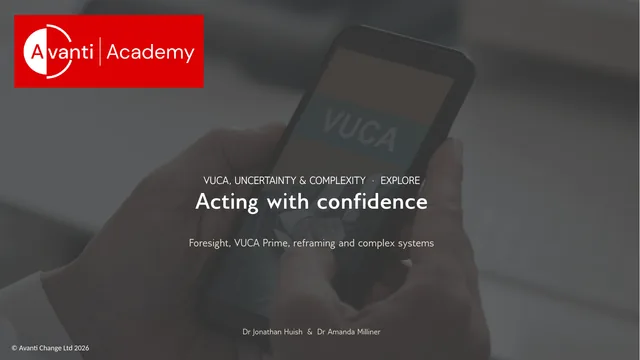
Captions and full transcripts on every slide · Organisations can pay by invoice
Course overview.
Some problems cannot be solved with more information. This topic helps you name the world you are leading in, using the Cynefin framework, tell wicked problems from tame ones, and act in complex systems through probe, sense and respond. It covers scenario planning and foresight, a considered response to VUCA, and how to frame and reframe problems with confidence.
What you will gain.
The world named clearly
Tell volatility, uncertainty, complexity and ambiguity apart, and respond to each.
Wicked, not just difficult
Recognise wicked problems and work with them rather than against them.
Confidence in the fog
Act through probe, sense and respond, and use foresight to see round corners.
See all 6 learning outcomes
By the end of this Immerse, you will be able to:
- Distinguish volatility, uncertainty, complexity and ambiguity, and identify which of the four mainly responds to more information.
- Explain the defining properties of a wicked problem, including no definitive formulation, no stopping rule and the one-shot nature of each attempt.
- Explain how Weick's sensemaking reverses the conventional analyse, decide, act sequence, and identify when careful analysis still fits better.
- Distinguish technical problems from adaptive challenges by asking whose behaviour, attitude or priority has to change.
- Distinguish an inherited frame from a chosen frame and explain how framing shapes both the solutions considered and the people involved.
- Identify how a single crisis moves between Cynefin domains, using Apollo 13 and the 2022 gilt crisis as examples.
The modules.
Focus · Making sense of the mess
4 modules · 2 hours 30 minutes01Foundations: Naming the World We're Actually Leading InFree Taster40 min
VUCA is often used as a shrug, yet each of its four letters names a different kind of difficulty that calls for a different response. This module recovers that precision, tracing the term from Bennis and Nanus to the US Army War College, introducing Jamais Cascio's BANI as a companion lens, and applying both to the compounding pressures of local government. It also names common misdiagnoses, including mistaking difficult for complex.
Bitesize: Naming the world we lead in, with module 102The Cynefin Framework: Making Sense of Complexity41 min
Before asking how to solve a problem, leaders need to ask what kind of problem it is. This module works through Snowden and Boone's Cynefin framework: the Clear, Complicated, Complex, Chaotic and Confused domains and the response each calls for. It adds Avanti's own mapping of member and officer relationships from Dr Huish's Cranfield research, the Palatine case, and the costly error of treating complex as complicated.
Bitesize: Naming the world we lead in, with module 203Wicked Problems and Tame Problems40 min
Some problems can be solved; others can only be managed. Drawing on Rittel and Webber's ten properties of wicked problems and Keith Grint's distinction between tame, critical and wicked problems, this module helps you match management, command or leadership to the problem in front of you. It explores clumsy solutions, the limits of New Public Management targets, and climate change as the archetypal wicked problem.
Bitesize: Wicked, not just difficult, with module 304Uncertainty, Ambiguity and Risk: Getting the Language Right38 min
Risk, uncertainty and ambiguity are routinely used as synonyms, yet each points to a different tool. Building on Frank Knight's distinction, Rumsfeld's known and unknown unknowns and Taleb's black swan, this module sets out a ladder from certainty to ambiguity, the two-person test and a familiarity and clarity grid, illustrated by the early weeks of Covid-19. It helps you name the gap honestly and match your response.
Bitesize: Wicked, not just difficult, with module 4
Focus · Finding a way through the fog
4 modules · 2 hours 30 minutes05Sensemaking in Complex Systems39 min
In complex conditions you often act your way to clarity rather than analysing your way there. This module introduces Karl Weick's sensemaking and its seven properties, especially the enactive idea that a team's story shapes what happens next, alongside the basics of complex adaptive systems: agents, feedback, emergence and non-linearity. The 2010 Flash Crash shows why hunting for a single root cause can fail, and three habits support learning forward.
Bitesize: Probe, sense, respond, with module 506Probe-Sense-Respond: Acting in the Complex Domain38 min
When you cannot analyse your way to an answer, you need a disciplined way to act. This module turns Snowden's probe, sense, respond into practice: what makes an experiment safe to fail rather than fail-safe, how probes quietly stop being safe, a five-step design sequence, and amplifying and dampening emergent patterns instead of mandating. The NHS vanguard sites show parallel probes, with honestly mixed results, at system scale.
Bitesize: Probe, sense, respond, with module 607Scenario Planning and Strategic Foresight38 min
You cannot predict the future, but you can rehearse for several of them. This module separates forecasting from scenario planning, traces the method from Pierre Wack's work at Shell before the 1973 oil shock to Peter Schwartz's The Art of the Long View, and sets out a four-step scenario matrix. It covers common pitfalls, revisiting scenarios over time, and applying the approach to the 2026 Devolution Act.
Bitesize: Seeing round corners, with module 708Leading Through Complexity: What's New Beyond Module 438 min
Complexity asks leaders to give up the instinct to look decisive. Building on a foundation of presence and communication, this module introduces Ronald Heifetz's adaptive leadership: technical problems versus adaptive challenges, getting on the balcony, and the holding environment with productive disequilibrium. It offers a calm, curious and committed presence triad, and uses Toyota's response to the 2011 earthquake and tsunami to show adaptive leadership under real pressure.
Bitesize: Seeing round corners, with module 8
Focus · Responding with confidence
4 modules · 2 hours 30 minutes09VUCA Prime: A Leader's Response Framework39 min
If VUCA is the diagnosis, Bob Johansen's VUCA Prime is the prescription: vision for volatility, understanding for uncertainty, clarity for complexity and agility for ambiguity. This module clears away common misreadings, unpacks each pairing in practice, and explores the tension between holding a vision and staying agile, summed up as the plan can flex while the direction holds. Ørsted's shift from fossil fuels to offshore wind illustrates it.
Bitesize: A considered answer to VUCA, with module 910Framing and Reframing Complex Problems37 min
How you frame a problem decides which solutions you can even see, and whom you invite to find them. This introductory module contrasts inherited and chosen frames, offers three opening questions from Avanti's client work, and introduces Toby Lowe's Human Learning Systems approach to public service complexity. It sets out ways to test a frame, including restating a problem five ways, and the common ways reframing goes wrong.
Bitesize: A considered answer to VUCA, with module 1011Organisations as Complex Adaptive Systems38 min
Organisations behave less like machines and more like weather systems. This module sets out four properties of organisations as complex adaptive systems: self-organisation, interdependence, adaptation and no single controller. It explains why command and control strains at scale while still belonging close to the work, uses the global semiconductor shortage to show locally sensible decisions adding up to an unintended failure, and offers four moves for leading systems.
Bitesize: Living systems, real cases, with module 1112Applied Case Studies: Capstone39 min
This capstone brings no new theory. Instead it reads three real moments, Apollo 13, the 2022 UK mini-budget and gilt crisis, and the UK Vaccine Taskforce, through the programme's frameworks, including Cynefin, Grint, probe-sense-respond and VUCA Prime. The cases show domains shifting mid-crisis, command and probing each used at the right moment, and leaders acting before certainty to learn their way to an answer.
Bitesize: Living systems, real cases, with module 12
Immerse Days and Programmes That Use This Topic
 Complexity, decisions and innovationWhen there is no right answerImmerse9 hours£249
 Complexity, decisions and innovationSeeing further, togetherImmerse8 hours£249
 Complexity, decisions and innovationFrom data to decisionsImmerse11 hours£249
 Communities and systemsBeyond our own wallsFlagship19 hours£499
 Serving the publicHolding steady, moving forwardFlagship27 hours 30 minutes£549
 Communities and systemsBeyond our own walls, togetherSignatureLive with Jon and AmandaBespokeTalk to us about Beyond our own walls, together →
 Serving the publicLeading as a politicianSignatureLive with Jon and AmandaBespokeTalk to us about Leading as a politician →
 Solving Complex Problems and Decision MakingClear calls in complex timesImmerse13 hours 30 minutes£249
 Creativity and InnovationThe innovation habitImmerse8 hours 30 minutes£249
 Crisis and Emergency LeadershipSteady in the stormImmerse11 hours£249
 Understanding Data and Data AnalysisBeyond the dashboardImmerse11 hours£249
Start small. Pay only the difference.
When you step up to a higher level, what you paid in the last 12 months for lower-level courses inside the bigger course comes off its price, in proportion to how much of each is inside it, whichever topic it's from. Courses at the same or a lower level don't give credit against each other. A Focus course or above always costs at least £15.