
Solving Complex Problems and Decision Making
Clear calls in complex times · 21 modules · 13 hours 30 minutes in all
Free with an account
Try It
Free, twenty minutes from the start of the topic.
Start Here
One complete idea, 1 hour 15 minutes.
The Whole Topic
Every module, in order: 13 hours 30 minutes.
Other sizes: see all 17 products
Bitesize
10 courses Solving Complex Problems and Decision MakingThe minds behind our choicesBitesize1 hour 15 minutes£39
 Solving Complex Problems and Decision MakingThe value of a dissenting voiceBitesize1 hour 15 minutes£39
 Solving Complex Problems and Decision MakingFast thinking, slow thinkingBitesize1 hour 15 minutes£39
 Solving Complex Problems and Decision MakingWeighing the optionsBitesize1 hour 15 minutes£39
 Solving Complex Problems and Decision MakingDifferent minds, different routesBitesize1 hour 15 minutes£39
 Solving Complex Problems and Decision MakingGetting to the root of itBitesize1 hour 15 minutes£39
 Solving Complex Problems and Decision MakingWhat matters mostBitesize1 hour 15 minutes£39
 Solving Complex Problems and Decision MakingCalm heads, clear callsBitesize1 hour 15 minutes£39
 Solving Complex Problems and Decision MakingFewer choices, better choicesBitesize1 hour 15 minutes£39
 Solving Complex Problems and Decision MakingHard calls, honestly madeBitesize45 minutes£39
Focus
5 courses Solving Complex Problems and Decision MakingHow we really decideFocus2 hours 30 minutes£69
 Solving Complex Problems and Decision MakingStructure before solutionsFocus2 hours 30 minutes£69
 Solving Complex Problems and Decision MakingEvidence and instinctFocus2 hours 30 minutes£69
 Solving Complex Problems and Decision MakingDeciding togetherFocus2 hours 30 minutes£69
 Solving Complex Problems and Decision MakingUnder pressure, with integrityFocus3 hours£69
Explore
2 courses
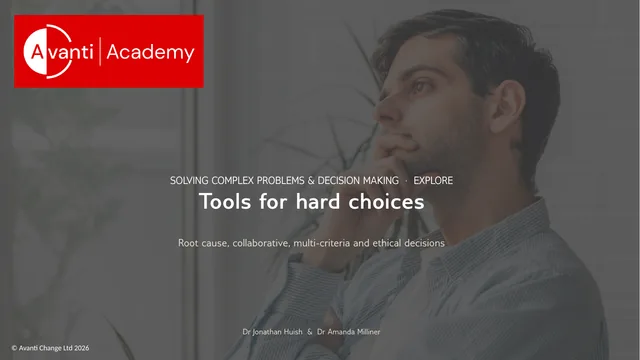
Captions and full transcripts on every slide · Organisations can pay by invoice
Course overview.
Solving a problem and making a decision are different kinds of work. This topic explains how we really decide, from fast and slow thinking to the minds behind our choices, then sets out structured ways to frame messy problems, get to root causes and weigh options. It looks at deciding together, the value of a dissenting voice, and making hard calls under pressure with integrity.
What you will gain.
Problems framed clearly
Structure messy problems and get to the root before reaching for solutions.
Better decisions, together
Use dissent well, avoid groupthink and weigh options fairly.
Clear calls under pressure
Decide with good judgement when time is short and the stakes are high.
See all 6 learning outcomes
By the end of this Immerse, you will be able to:
- Distinguish problem solving as diagnostic and generative work from decision making as evaluative and committal work.
- Describe groupthink and identify its four symptoms while a decision is still open.
- Describe the steps of a cost benefit analysis and how social cost benefit analysis adapts them for public decisions.
- Apply the five whys to a recurring problem, continuing until the answer would genuinely prevent recurrence.
- Explain Klein's recognition primed decision model and why expert recognition under pressure is not guesswork.
- Analyse a decision failure by asking when somebody knew, what the warning met, and who would have had to lose.
The modules.
Focus · How we really decide
4 modules · 2 hours 30 minutes01Foundations: Problem Solving and Decision Making Are Not the Same SkillFree Taster37 min
This opening module separates two skills leaders often blur together: problem solving, which asks what is true, and decision making, which asks what to do about it. It sets out two failure modes and their different fixes, shows how to keep the disciplines in sequence in a real meeting, and explains how the programme is organised, from Simon and prospect theory to structured methods and collaborative decision making.
Bitesize: Solving is not deciding, with module 102Decision Types, Conditions and the Classical Model38 min
This module builds the shared vocabulary for deciding well. It distinguishes programmed from non programmed decisions, sets out the conditions of certainty, risk, uncertainty and ambiguity, and walks through the classical six step rational decision model, drawing on Daft and Harrison, including the three ordered tests of feasibility, satisfactoriness and affordability. It treats the model as a benchmark and offers four questions to ask before any decision.
Bitesize: Solving is not deciding, with module 203Bounded Rationality: How Decisions Really Get Made39 min
Intelligent, well informed people still do not optimise, and this module explains why. It draws on Herbert Simon's administrative model, bounded rationality and satisficing, and on Mintzberg's non sequential model of identification, development and selection. The Kodak digital camera case shows how a run of individually satisfactory decisions can prove fatal, and the module offers practical questions for testing whether good enough is still good enough.
Bitesize: The minds behind our choices, with module 304Prospect Theory: How We Really Weigh Gains and Losses38 min
This module explores Kahneman and Tversky's prospect theory and its three building blocks: loss aversion, reference dependence and diminishing sensitivity. It shows how losses loom roughly twice as large as equivalent gains, how gain and loss framing changes choices, and why sunk cost reasoning keeps failing projects alive, using the Concorde case. It offers practical habits and questions for separating a decision that protects a loss from one that weighs a future.
Bitesize: The minds behind our choices, with module 4
Focus · Structure before solutions
4 modules · 2 hours 30 minutes05Groupthink and the Discipline of Dissent39 min
Groups fail in their own distinctive way, and this module explains how. Drawing on Irving Janis's work on groupthink and the Bay of Pigs, it sets out four observable symptoms, including self censorship and the illusion of unanimity, and why capable, cohesive groups are most exposed. It then matches practical countermeasures, such as a devil's advocate, independent sub groups and leaders speaking last, to the failures they address, so dissent is designed in rather than hoped for.
Bitesize: The value of a dissenting voice, with module 506Problem Structuring Methods: Making Sense of Messy Choices40 min
Some problems are hard because people disagree about what the problem is. This module introduces four problem structuring methods for those situations: Checkland's Soft Systems Methodology with rich pictures and CATWOE, Friend's Strategic Choice Approach and its three kinds of uncertainty, Eden's SODA cognitive mapping, and Rosenhead's Robustness Analysis. It explains that soft describes the problem, not the rigour, and offers four questions usable without training.
Bitesize: The value of a dissenting voice, with module 607Kepner Tregoe and the OODA Loop: Two Speeds of Structured Thinking39 min
This module sets two structured methods side by side: Kepner and Tregoe's slow, thorough separation of problem analysis from decision analysis, and John Boyd's fast, iterative OODA loop of observe, orient, decide and act. It explains why assumptions must never quietly become facts, why orientation is the decisive stage, and why a faster cycle can beat a better machine. The core skill is choosing the right speed of thinking for the situation.
Bitesize: Fast thinking, slow thinking, with module 708Decision Rights: Who Should Actually Decide38 min
Most decisions are shaped before anyone sits down to make them, by who is involved and who owns the outcome. This module uses the Vroom Yetton Jago model to treat involvement as a situational judgement, from deciding alone to delegating, and examines the costs of too little and too much consultation. It then separates involvement from ownership, drawing on decision rights frameworks, with four roles to assign so decisions do not drift.
Bitesize: Fast thinking, slow thinking, with module 8
Focus · Evidence and instinct
4 modules · 2 hours 30 minutes09Cost Benefit and Market Analysis: Valuing Your Options38 min
Once options exist, someone has to work out what each is worth. This module covers cost benefit analysis from Jules Dupuit's original method to social cost benefit analysis, with six steps grouped into three jobs, and the ways an analysis quietly misleads, including forced numbers. It pairs this with market analysis and the 6W customer analysis model, showing how genuine rather than assumed need defines the options worth valuing.
Bitesize: Weighing the options, with module 910Understanding Data: The Evidence Base for Good Decisions39 min
Every technique in this programme depends on the evidence feeding it. This module applies Deming's standard of accurate, valid, precise and reliable data, sets out the main types of data and what each can legitimately support, and covers how primary data is collected, including why a survey is only as good as its design. The 2020 A Level grading algorithm shows how capable people produced a confident, precise and wrong answer.
Bitesize: Weighing the options, with module 1011Design Thinking: One Technique Among Several38 min
This module offers a deliberately bounded introduction to design thinking as one problem solving technique among several, as used in Avanti's work with a local authority. It covers starting from the person rather than the specification, combining divergent and convergent thinking in sequence, and IDEO's three tests of desirable, feasible and viable. IDEO's four day shopping cart redesign shows the method in action, and four simple moves bring it into everyday work.
Bitesize: Different minds, different routes, with module 1112Adaptors and Innovators: Kirton's KAI and Problem Solving Style39 min
People who approach problems differently often misjudge each other, and this module offers a vocabulary for that. It introduces Michael Kirton's Adaption Innovation continuum, what KAI does and does not measure, and three common misreadings. It explores what adaptors and innovators each bring, how they misjudge one another under pressure, and how to read friction as difference rather than conflict, before turning to designing, matching and sequencing a mixed team.
Bitesize: Different minds, different routes, with module 12
Focus · Deciding together
4 modules · 2 hours 30 minutes13Root Cause Before Solution: Five Whys and the Fishbone Diagram37 min
How you frame a problem decides which solutions you can see. This module covers two simple root cause techniques from the Toyota Production System tradition: the five whys, associated with Taiichi Ohno, which follows one chain of reasoning in depth, and Ishikawa's fishbone diagram, which widens the search across fixed categories first. It shows how to run both well in a meeting, how they fit together, and why the discipline matters more than the technique.
Bitesize: Getting to the root of it, with module 1314Deciding Together: Collaborative and Participative Decision Making39 min
This deliberately narrow module asks whether a decision is genuinely made with the people it affects, or made for them and then announced. It sets out a collaboration spectrum from competing to co-designing, separates coordinating from collaborating, and adapts Habermas's principles of communicative rationality into three tests of comprehensibility, sincerity and legitimacy. Porto Alegre's participatory budgeting shows what binding citizen authority, combined with technical scrutiny, can look like.
Bitesize: Getting to the root of it, with module 1415Applied Case Studies: Capstone39 min
This capstone brings no new theory. It reduces the toolkit to three questions, diagnose well, decide well and revisit both honestly, and applies it to three verified cases: the Boeing 737 MAX and MCAS, New Coke, and Birmingham City Council's Oracle programme. Each case is read against decision rights, satisficing, groupthink, market analysis, prospect theory and cost benefit analysis, showing how pressure overrides evidence and how to notice it in time.
Bitesize: What matters most, with module 1516Multi Criteria Decision Analysis: Weighing What Matters39 min
Many public decisions involve cost, quality, risk, community impact and deliverability, and forcing them into one number is not always honest. This module introduces Multi Criteria Decision Analysis as a way to make judgement visible: four steps from criteria to choice, simple weighted scoring and Saaty's Analytic Hierarchy Process, and its place in HM Treasury's Green Book. It stresses agreeing weights before scores and shows how the same framework can test or merely decorate a decision.
Bitesize: What matters most, with module 16
Focus · Under pressure, with integrity
5 modules · 3 hours17Naturalistic Decision Making: How Experts Decide Under Pressure38 min
Under real time pressure, nobody runs the six step model. This module draws on Gary Klein's fireground research and the recognition primed decision model to show how experts decide well under pressure: recognising a pattern, simulating one option once, then committing. Captain Sullenberger's 208 second decision on the Hudson illustrates the pattern, and the module is honest about when recognition lets you down and how to build expertise through after action review.
Bitesize: Calm heads, clear calls, with module 1718The Delphi Method and Group Forecasting38 min
Put experts in a room and the loudest or most senior voice usually wins. This module explains how the Delphi Method, developed at the RAND Corporation and still used in clinical guideline work, removes that distortion through anonymous rounds, controlled feedback and iteration. It covers the facilitator's responsibilities, when Delphi fits and when it does not, four ways it fails, and why a well documented disagreement is a legitimate answer.
Bitesize: Calm heads, clear calls, with module 1819The Paradox of Choice and Decision Fatigue38 min
This module turns from the decision to the decision maker. It draws on Barry Schwartz's paradox of choice to show why more options can leave people more anxious and less satisfied, and on decision fatigue to show how judgement degrades across a day of decisions. The hungry judge study and Gloeckner's reanalysis model how to cite challenged evidence honestly, and practical responses work at personal and organisational levels.
Bitesize: Fewer choices, better choices, with module 1920Ethical Decision-Making Frameworks38 min
Some decisions are not missing information; they are genuine clashes of value. This module shows how to recognise an ethical decision and test it against three classical lenses: utilitarian (Bentham and Mill), deontological (Kant) and virtue based (Aristotle). A council budget dilemma shows how lenses can agree on different foundations or disagree, and NICE's cost per QALY threshold models naming a hard trade off openly rather than hiding it in a number.
Bitesize: Fewer choices, better choices, with module 2021Applied Case Studies II: A Second Capstone39 min
This second capstone brings no new theory. It recaps the frameworks from across the programme, adding multi criteria analysis, naturalistic decision making, Delphi, decision fatigue and ethics, and applies them to three current failures: Australia's Robodebt scheme, the Columbia shuttle disaster, and Winter Storm Uri in Texas. Each case shows a warning already in the room that met no route to change course, and closes with diagnose honestly, decide deliberately, own the trade off.
Bitesize: Hard calls, honestly made, with module 21
Immerse Days and Programmes That Use This Topic
 Strategy and the futureClear heads on AIImmerse10 hours 30 minutes£249
 Complexity, decisions and innovationWhen there is no right answerImmerse9 hours£249
 Complexity, decisions and innovationSeeing further, togetherImmerse8 hours£249
 Serving the publicWhen things go wrongImmerse8 hours 30 minutes£249
 Leading peopleRaising the team’s gameImmerse9 hours£249
 Complexity, decisions and innovationBetter ideas, made togetherImmerse9 hours£249
 Complexity, decisions and innovationThe worst dayImmerse9 hours 30 minutes£249
 Complexity, decisions and innovationFrom data to decisionsImmerse11 hours£249
 Complexity, decisions and innovationLeading with data and digitalFlagship26 hours 30 minutes£549
Start small. Pay only the difference.
When you step up to a higher level, what you paid in the last 12 months for lower-level courses inside the bigger course comes off its price, in proportion to how much of each is inside it, whichever topic it's from. Courses at the same or a lower level don't give credit against each other. A Focus course or above always costs at least £15.